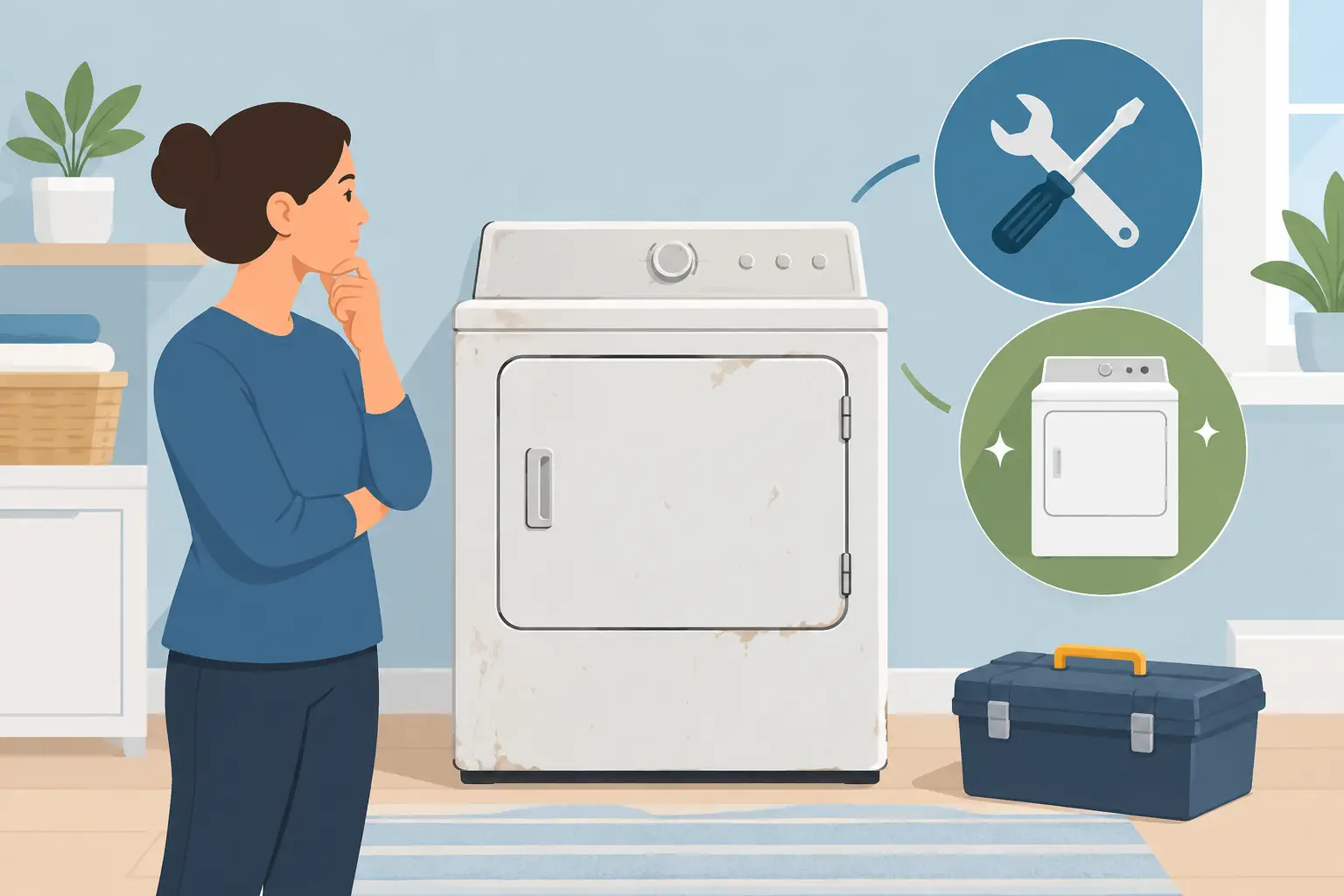
A dryer that suddenly needs two cycles, makes a scraping sound, or stops heating can derail an entire household routine. When the question is, “should I repair old dryer problems or replace the machine?” the answer usually comes down to more than its age. The specific failed part, the dryer’s condition, safety concerns, and the cost of a reliable repair all matter.
For many Orange County homeowners, an older dryer is still worth fixing. Dryers are relatively straightforward appliances, and a well-maintained model can often deliver years of additional service after the right repair. The key is getting an accurate diagnosis before spending money on a part you may not need.
Should I Repair an Old Dryer or Replace It?
A dryer does not become a lost cause simply because it is old. Many common failures involve components that can be replaced without rebuilding the entire appliance. A worn belt, faulty thermal fuse, broken heating element, failed igniter, damaged rollers, or defective door switch may stop the dryer from working properly, but these issues are often repairable.
As a general rule, repair is usually the practical choice when the dryer is under about 10 to 13 years old, has been dependable until now, and the repair cost is clearly lower than purchasing and installing a comparable replacement. This is especially true when the appliance is a higher-end or built-in laundry model, where replacement can involve more than the price of the dryer itself.
Replacement deserves stronger consideration when several expensive parts have failed in a short period, the dryer has a cracked drum or serious corrosion, or the estimated repair is close to half the cost of a suitable new machine. A technician should be able to explain that distinction plainly, not pressure you toward a repair that does not make financial sense.
Start With the Problem, Not the Birthday of the Dryer
The symptoms often tell a better story than the manufacture date. An older dryer that runs quietly and only needs a heating element may be a strong repair candidate. A newer unit that has repeated electrical failures, a damaged control board, and a noisy drum could be less appealing to repair.
No heat, but the drum still turns
When the drum turns but clothes remain damp, the issue may be a heating element in an electric dryer, an igniter or gas valve component in a gas dryer, or a failed thermostat or thermal fuse. Restricted venting can produce similar symptoms and may cause the dryer to overheat and shut down.
This is one situation where a professional diagnosis matters. Replacing a heating part without checking airflow can leave the underlying problem in place. A clogged or improperly routed vent can shorten the life of both old and new dryers.
Loud thumping, squealing, or scraping
Unusual noise commonly points to worn drum rollers, a belt, an idler pulley, or glides that support the drum. These are mechanical wear items, and they can often be replaced at a reasonable cost. Addressing them early may prevent a small noise from becoming a damaged drum or motor problem.
A metal-on-metal scraping sound, a drum that wobbles, or a dryer that leaves marks on clothing should not be ignored. Continued use can raise the final repair cost and create a greater risk of damage to garments.
The dryer shuts off or will not start
A dryer that will not start may have a failed door switch, start switch, thermal fuse, power issue, or control problem. If it starts and stops unpredictably, overheating, ventilation restrictions, a motor issue, or an electronic control fault may be involved.
These symptoms have a wide range of possible causes. They are not a good fit for guesswork, especially on gas dryers or premium electronic models. A trained technician can test the appliance, identify the failed component, and give you a clear estimate before work begins.
Use Repair Cost as a Decision Tool
It helps to compare the complete repair estimate with the real cost of replacement. That replacement number should include delivery, installation, haul-away, any needed electrical or gas connection work, and the time spent selecting a model that fits your laundry space.
A simple cost guideline can help, but it is not absolute. If a repair costs far less than half the price of a comparable replacement and the dryer is otherwise in solid condition, repair is generally reasonable. If the repair approaches half the replacement cost on a machine already near or beyond its expected service life, replacement may offer better value.
Consider the type of dryer as well. A basic vented dryer is usually less expensive to replace than a premium model with moisture sensors, steam functions, specialized controls, or a matching stacked configuration. For Miele, Bosch, Thermador, Viking, and other high-end laundry equipment, a targeted repair can be particularly worthwhile because a replacement unit may carry a much higher purchase and installation cost.
Safety Issues Change the Answer
Some dryer problems should be handled immediately rather than monitored for another week. A burning smell, visible sparking, repeated breaker trips, gas odor, smoke, or a dryer that becomes excessively hot calls for stopping use and arranging service promptly.
Lint buildup is another concern. Lint is normal, but lint accumulation inside the cabinet or a blocked exhaust system is not. Poor airflow makes drying slower, wastes energy, overheats components, and can create a fire risk. Cleaning the lint screen after every load is helpful, but it does not replace proper vent inspection and cleaning when performance declines.
Gas dryers require extra caution. If you smell gas, leave the area, avoid operating switches or appliances nearby, and follow your gas utility’s safety guidance. Do not attempt to disassemble gas connections yourself.
Efficiency Matters, but It Is Not the Whole Story
New dryers may offer improved sensors, cycle options, and efficiency features. That can be appealing if your current dryer runs long cycles, overheats laundry, or regularly requires repeat loads. Still, a new dryer is not automatically the economical choice just because it uses less energy.
A repaired dryer that dries a full load correctly can remain a sensible household appliance. In many cases, poor drying performance is caused by a repairable heating issue or restricted venting rather than the dryer being inherently inefficient. Replacing an appliance before confirming the cause can mean paying for a new machine while leaving a vent problem unresolved.
If you are considering replacement for energy savings, think about your actual laundry habits. A large family running multiple loads each week may see greater benefit from upgraded capacity and sensors than a one- or two-person household with lighter use.
What to Expect From a Professional Dryer Diagnosis
A useful service visit should give you information, not just a repair recommendation. The technician should inspect the dryer’s operation, test relevant components, look for airflow or venting concerns, and explain the likely cause in everyday terms.
You should receive a clear estimate that separates the repair decision from the initial diagnosis. At AK Appliance Repair, the $75 service fee is waived when you proceed with a repair, helping homeowners make a practical decision after the issue has been identified. Genuine factory parts also matter when the failed component affects heating, safety systems, drum support, or electronic controls.
Before approving work, ask how the repair addresses the current symptom, whether other worn parts were found, and whether the technician sees any reason replacement would be the smarter option. An honest answer may be that your old dryer is worth saving, or that it is time to put repair dollars toward a new unit.
Keep a Repairable Dryer Running Longer
Once your dryer is working properly, basic care can help protect the repair. Clean the lint screen after each use and avoid running the dryer with a clogged screen. Keep the area around the appliance clear, use the correct cycle for the fabric, and avoid consistently overloading the drum.
Pay attention when drying times begin to creep up. A load that once dried in 45 minutes but now takes two cycles is asking for attention. Scheduling service at that stage can be less disruptive than waiting until the dryer stops in the middle of a busy week.
The right decision is not always to repair and not always to replace. It is the option that restores safe, dependable laundry service at a cost that makes sense for your home. A straightforward diagnosis gives you the facts to make that call with confidence.