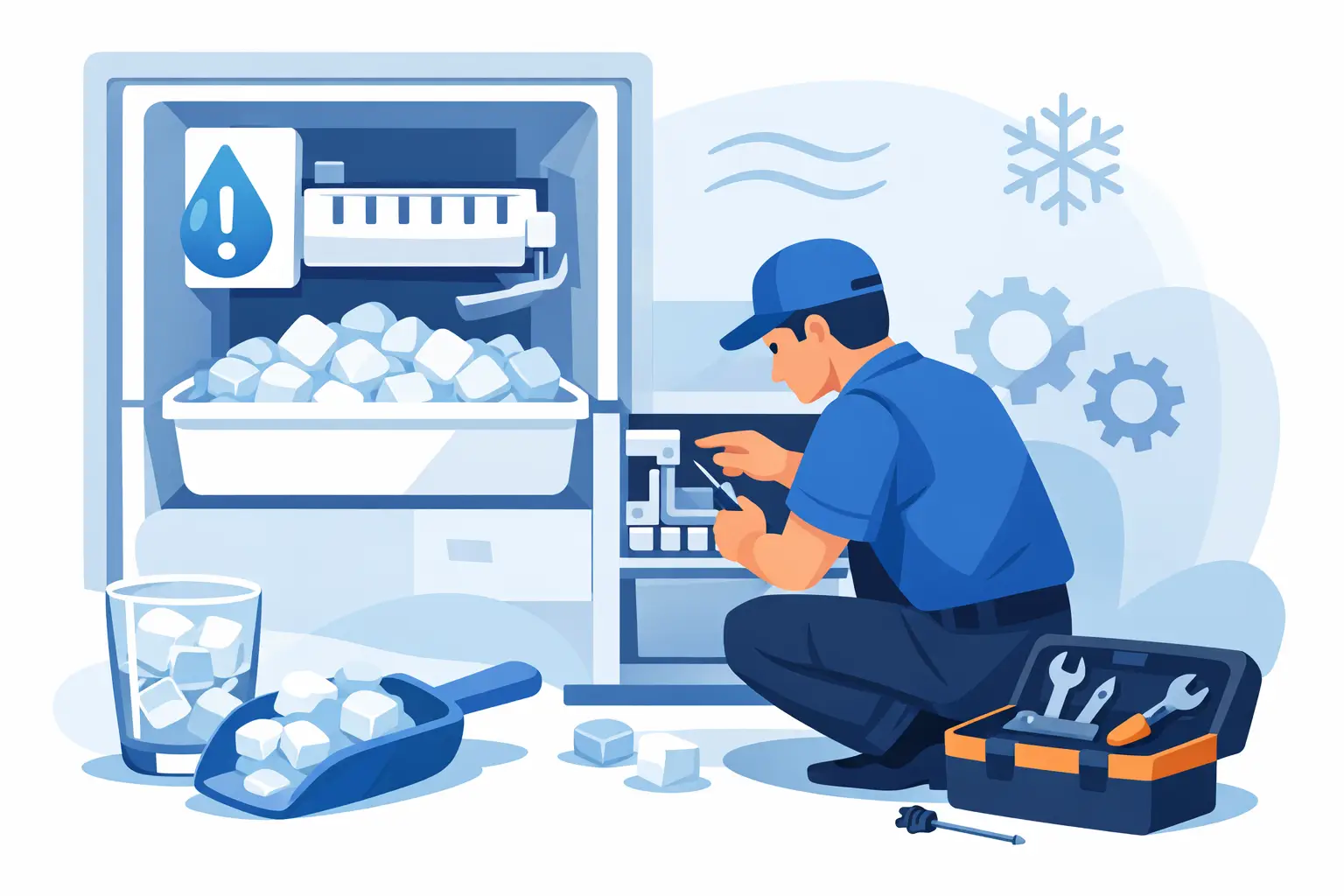
A working ice maker is easy to overlook until the bin is empty before dinner, the cubes are tiny, or water appears beneath the refrigerator. Freezer ice maker repair starts with identifying whether the problem is water supply, freezer temperature, a blocked ice path, or a failed component. A quick check can rule out a simple issue, but many ice maker failures need an accurate in-home diagnosis before they lead to leaks, spoiled food, or damage to the refrigerator.
Signs Your Ice Maker Needs Attention
Ice makers rarely fail in just one way. Some stop producing ice completely, while others make hollow cubes, dispense clumps, freeze into one solid block, or leak into the freezer compartment. These symptoms can look minor at first, but they often point to a problem that will not correct itself.
If your ice maker is making no ice, check whether the ice maker is switched on and whether the freezer door is closing fully. A door that stays slightly open can raise the freezer temperature enough to interrupt the ice-making cycle. Also look at the water dispenser, if your refrigerator has one. When both the dispenser and ice maker have weak or no water flow, the supply line, shutoff valve, or water filter may be involved.
Slow production is different from no production. Most household ice makers need several hours to make their first batch after the freezer has been opened, stocked heavily, or recently adjusted. However, if production stays slow for days, the freezer may not be cold enough or the ice maker may not be filling correctly. Small, cloudy, or hollow cubes commonly indicate limited water entering the mold.
A full bin with no ice coming through the dispenser can be a separate issue. Ice can melt slightly and refreeze into a solid mass, especially when the freezer door is opened often or does not seal tightly. The dispenser chute, auger motor, or ice bucket mechanism may also be jammed or worn.
A Few Safe Checks Before Scheduling Freezer Ice Maker Repair
Homeowners can make a few basic checks without taking apart the refrigerator. First, confirm the freezer temperature is set near 0 degrees Fahrenheit. A freezer that runs too warm may still keep food frozen while remaining too warm for reliable ice production.
Next, inspect the water filter. A filter that is overdue for replacement can restrict water flow, resulting in small cubes or a slow fill. Replace it only with the correct filter for your refrigerator model and follow the manufacturer instructions for flushing it afterward. If the issue began immediately after installing a new filter, make sure it is fully seated and compatible with the appliance.
Check the ice bin for fused cubes and remove loose ice that is blocking the bucket. Do not chip at ice with a knife, screwdriver, or other sharp tool. It is easy to crack a plastic liner, puncture a water line, or damage the ice maker itself. If a section is frozen solid, allow it to thaw naturally after moving food to a safe location.
Finally, look behind the refrigerator only if it can be done safely. A kinked water line can reduce water flow. Avoid pulling a heavy refrigerator far from the wall without help, especially on tile or hardwood floors. Never attempt electrical testing, wiring repairs, or valve replacement while the refrigerator is connected to power and water.
What Usually Causes Ice Maker Problems
Water flow restrictions
An ice maker needs a measured amount of water during each cycle. A clogged filter, partially closed shutoff valve, kinked supply line, or failing inlet valve can prevent the mold from filling. In some cases, the fill tube freezes shut, so water cannot reach the ice maker even though the water system is otherwise working.
A frozen fill tube may be a symptom rather than the root cause. Low water pressure, a valve that drips after closing, or unstable freezer temperatures can allow ice to form where it should not. Simply thawing the tube may restore production briefly, but the same obstruction can return if the underlying issue is not corrected.
Freezer temperature and airflow issues
Ice makers depend on a consistently cold freezer. Frost buildup on an evaporator, a weak fan motor, damaged door gaskets, or a defrost system problem can raise temperatures and reduce ice production. You may also notice soft ice cream, excess frost, or food freezing unevenly.
Overpacking can contribute to airflow problems, particularly when packages block vents near the back wall. Rearranging food may help, but persistent frost or temperature changes deserve professional attention. Those signs can involve parts of the refrigerator system beyond the ice maker.
Worn mechanical or electrical parts
Traditional ice makers use a motorized module, heater, thermostat, sensors, and ejector components to release each batch of ice. Newer refrigerator models may use electronic controls, optical sensors, and dedicated ice compartments. A failed component can stop the cycle at any point: no water enters, cubes do not release, or the ice maker does not recognize that the bin is full.
The right repair depends on the model and the failed part. Replacing an entire ice maker assembly can make sense when multiple internal components are worn. In other cases, replacing a water inlet valve, sensor, fan, control board, or damaged ice bucket is the more practical and cost-effective repair.
Dispenser and ice bucket problems
A refrigerator may be making ice normally but still fail to dispense it. Clumped ice is common in humid conditions and in homes where the freezer door is frequently opened. A cracked bucket, stripped auger, broken drive coupler, or weak dispenser motor can also prevent ice from moving forward.
This is one reason a clear diagnosis matters. Replacing the ice maker will not solve a failed auger motor, and replacing a dispenser part will not help if the freezer is too warm to make ice in the first place.
When to Call for Professional Ice Maker Service
Call for service when there is a leak, recurring frozen water line, repeated ice buildup, a warm freezer, electrical odor, unusual grinding, or no ice after the basic checks. Water leaks deserve prompt attention because they can damage flooring, cabinetry, and nearby walls. Turn off the refrigerator water supply if water is actively leaking, and place towels around the area until help arrives.
Professional freezer ice maker repair is also the safer choice for built-in, premium, and luxury refrigerators. Models from Sub-Zero, Thermador, Miele, Viking, Wolf, Bosch, Fisher & Paykel, and other specialized brands can use model-specific components and controls. Accurate testing helps avoid installing the wrong part or causing a larger refrigeration problem.
For Orange County homeowners, AK Appliance Repair provides in-home diagnostics and repair for standard and premium refrigerator brands. A technician can inspect the water system, freezer performance, ice maker assembly, sensors, dispenser components, and controls, then provide a clear estimate before repair work begins. The $75 service fee is waived when you proceed with the repair.
What a Proper Repair Visit Should Accomplish
A useful service call should do more than get a tray to make one batch of cubes. The technician should identify why the failure occurred, verify the appliance is reaching the proper temperature, and test the ice maker through its relevant functions. That may include checking water pressure and fill time, inspecting for frozen lines, confirming fan operation, examining the dispenser system, and testing electrical components.
After the repair, ice production may still take time to return. Depending on the refrigerator and freezer temperature, the first batch can take several hours, and a full bin may take a day or longer. This is normal as long as the appliance is cooling correctly and new cubes are being produced consistently.
Help Your Ice Maker Stay Reliable
Replace water filters on schedule, keep freezer vents clear, and close the door firmly after use. If ice is rarely used, empty the bin periodically so old cubes do not absorb odors or fuse together. Avoid setting the freezer colder than necessary in an attempt to speed up ice production, since overly cold settings can contribute to frozen fill tubes and uneven refrigerator temperatures.
When your ice maker stops keeping up, acting early is usually easier than waiting for a leak or a freezer-wide frost problem. A clear diagnosis and the right replacement part can get the household back to dependable ice without replacing a refrigerator that still has years of service left.