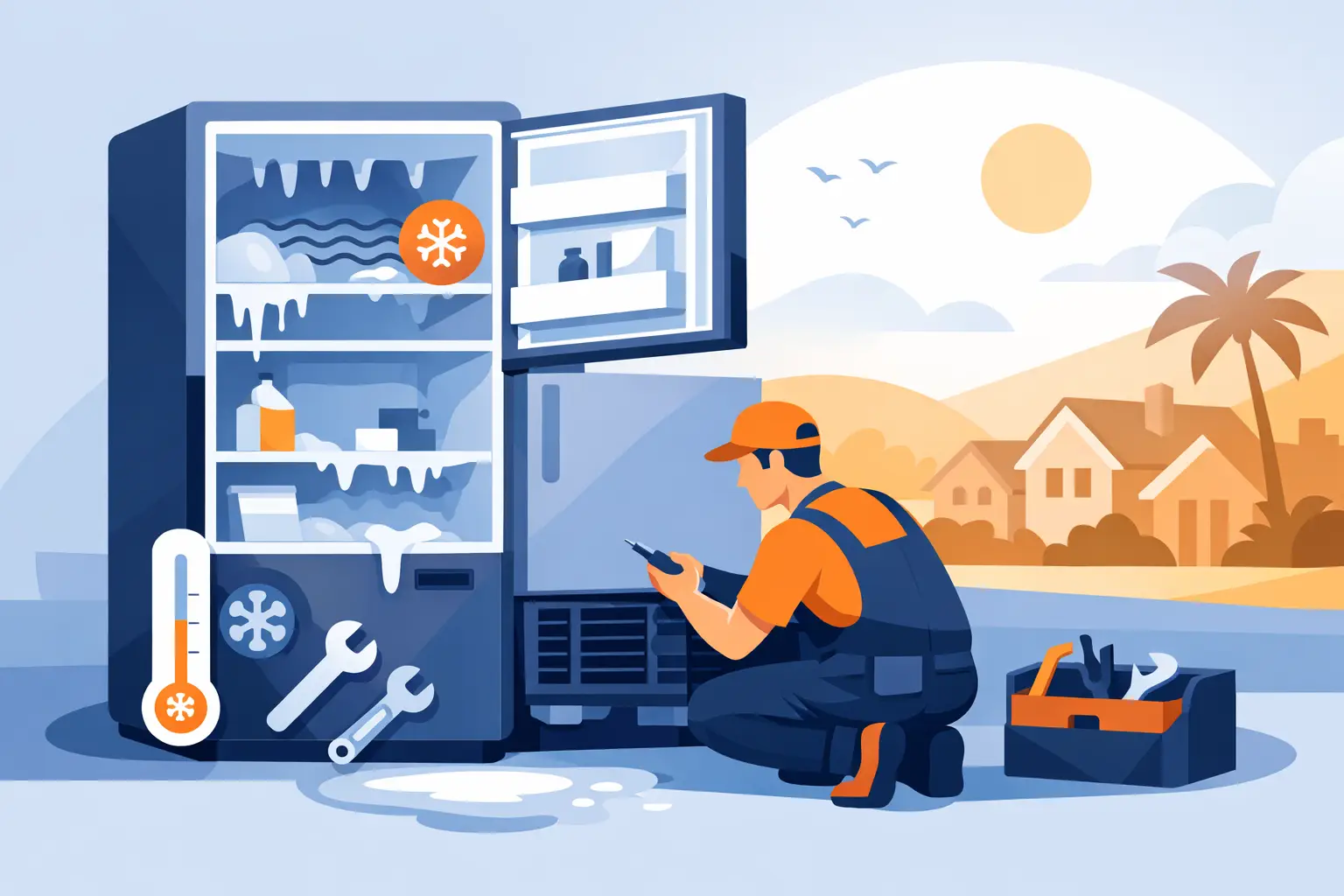
A refrigerator that suddenly feels warm can turn an ordinary evening into a race to save groceries. Refrigerator not cooling repair starts with knowing whether you are dealing with a simple airflow issue, a setting problem, or a mechanical failure that needs prompt in-home service. The difference matters when a refrigerator holds a full week of food, especially during a busy Orange County household schedule.
Before moving food or trying a repair, check the temperature with an appliance thermometer if you have one. A refrigerator should generally stay at or below 40°F, while the freezer should be at 0°F. If the refrigerator has been above 40°F for several hours, protect perishable food first. Meat, dairy, leftovers, and other refrigerated items may no longer be safe even if they still look and smell normal.
Start With the Signs You Can See and Hear
The way your refrigerator behaves gives a technician useful clues. A completely silent refrigerator with no interior light may have a power supply issue. A refrigerator that has lights but no cooling may have a failed compressor relay, control board, fan motor, or sealed-system problem. If the freezer is cold but the fresh-food section is warm, airflow is often the first place to look.
Notice whether you hear the usual low hum from the back of the unit, a fan running inside the freezer, repeated clicking, or a new buzzing sound. Repeated clicking every few minutes can indicate that the compressor is struggling to start. A loud fan noise, frost buildup, or weak air coming from the vents can point to a defrost or circulation issue.
You do not need to diagnose the part yourself. Clear observations such as “the freezer is cold but the refrigerator is warm” or “the compressor clicks but does not start” help speed up the service visit and lead to a more accurate repair recommendation.
Safe Checks Before Refrigerator Not Cooling Repair
A few basic checks are reasonable for homeowners, as long as they do not involve electrical components, refrigerant lines, or disassembly. Start by confirming the refrigerator has power. Check that the plug is firmly seated and that the outlet has not tripped. If the interior lights work, power is reaching the appliance, but that does not mean the cooling system is operating correctly.
Next, look at the temperature controls. A dial can be bumped while loading groceries, and a digital panel may have been set to a warmer temperature or placed in vacation mode. Return the controls to their normal setting, then allow time for the appliance to respond. A refrigerator can take several hours to stabilize after an adjustment, especially if the doors have been opened often.
Make sure nothing is blocking the interior air vents. In many models, cold air moves from the freezer compartment into the refrigerator section through vents near the back wall. Large containers pushed tightly against those vents can restrict airflow. Rearrange items to leave some space around the vents, and avoid overfilling shelves.
Check the door gaskets as well. A torn, loose, or dirty gasket allows warm kitchen air into the compartment. You may see condensation around the door frame, excessive frost in the freezer, or food that stays cold only near the back. Wipe the gasket clean and look for visible damage. If it does not seal evenly, replacement may be the practical solution.
Dirty Condenser Coils Can Reduce Cooling
Condenser coils release heat from the refrigerator. On many models, they are located underneath or behind the appliance. When dust, pet hair, and debris build up around them, heat cannot escape as efficiently. The refrigerator may run longer than usual, feel hot near the bottom, and struggle to maintain a safe temperature.
If you can safely access the coils, unplug the refrigerator first. Use a coil brush or vacuum carefully to remove surface debris around the grill and coil area. Do not bend tubing, pull on wires, or force access panels. Built-in, counter-depth, and premium refrigerators can have more complex access points, so it is often better to leave this step to a technician if you are unsure.
Cleaning coils can improve performance when restricted airflow is the problem. It will not fix a failing compressor, damaged fan, refrigerant leak, faulty defrost system, or electronic control issue. If cooling does not improve after the coils are cleaned and the appliance has had time to run, professional diagnosis is the next step.
Why the Freezer May Be Cold While the Refrigerator Is Warm
This is one of the most common and confusing refrigerator failures. The freezer creates the cold air, then a fan and damper system distribute some of that air into the refrigerator compartment. When airflow is blocked or a component fails, the freezer may continue to seem normal while milk, produce, and leftovers in the refrigerator section warm up.
Heavy frost on the freezer’s back panel often suggests a defrost failure. During normal operation, the refrigerator periodically melts frost from the evaporator coil. If the defrost heater, sensor, timer, or control board fails, ice can build up until air can no longer pass through the coil. The appliance may still run constantly, but cold air will not circulate where it is needed.
A failed evaporator fan can cause similar symptoms. The fan is responsible for moving cold air across the evaporator and through the compartments. A technician can test the fan, damper, sensors, and defrost components without guesswork and replace the failed part when appropriate.
When a Compressor or Sealed-System Problem Is More Likely
A warm refrigerator that runs continuously, clicks repeatedly, or has a very hot compressor area may have a more serious cooling-system concern. The compressor, start device, condenser fan, evaporator, and refrigerant system work together. A problem with any of these parts can prevent the appliance from removing heat effectively.
Sealed-system repairs are not a homeowner project. Refrigerant handling requires proper equipment and training, and the source of a leak must be identified before simply adding refrigerant. Otherwise, the cooling problem can return quickly. The right recommendation depends on the refrigerator’s age, condition, repair history, part availability, and the specific brand and model.
For a newer or high-value refrigerator, repair is frequently worth considering. This is especially true for built-in and luxury models from Sub-Zero, Thermador, Miele, Viking, Wolf, and Fisher & Paykel, where replacement can be a significant household expense. For an older standard refrigerator with a major compressor failure, an honest technician should explain the repair cost alongside the likely value of replacement.
Do Not Ignore Water, Burning Smells, or Tripped Breakers
Some refrigerator problems call for immediate action rather than waiting to see whether the temperature recovers. Unplug the appliance and arrange service if you notice a burning odor, smoke, sparking, a repeatedly tripped breaker, or electrical scorching near the outlet. These symptoms can indicate a wiring or component failure.
Water around the refrigerator also deserves attention. A clogged defrost drain, leaking water line, damaged ice maker connection, or overflowing drain pan can damage flooring and cabinets. If water is close to electrical connections, avoid handling the appliance until it can be assessed safely.
What to Expect From a Professional Diagnosis
A proper refrigerator service visit should do more than replace a part based on a symptom. The technician should check temperatures, airflow, fans, frost patterns, control settings, electrical components, and the condition of the cooling system. That process identifies the actual source of the failure and helps prevent paying for an unnecessary repair.
At AK Appliance Repair, Orange County homeowners can expect an in-home diagnosis, a clear estimate before repair work begins, and straightforward recommendations based on the condition of the appliance. The $75 service fee is waived when you proceed with a repair, and technicians use genuine factory parts when replacement components are needed.
If food is at risk, move what you can to a cooler or another refrigerator, keep the doors closed as much as possible, and schedule service promptly. A fast, accurate repair can be the difference between restoring a dependable kitchen appliance and losing a refrigerator full of groceries.