A cake that browns too fast on top, cookies that stay pale after the timer ends, or a casserole that takes an extra 20 minutes can all point to the same frustrating issue: your oven may not be reaching or holding the temperature shown on its display. Learning how to test oven temperature accuracy can help you separate a minor calibration issue from a repair problem that could keep interrupting meals.
Before assuming the oven needs replacement, take a few careful readings. Many temperature concerns can be traced to an aging sensor, a failing bake element, a door that does not seal properly, or a control issue that can be repaired in your home.
Why Oven Temperature Can Be Off
An oven does not heat continuously to one exact number. It cycles on and off around the selected temperature. For example, an oven set to 350°F may rise somewhat above that point, then fall below it before the heating element or gas burner turns on again. That cycling is normal.
The concern is the average temperature over time. If your oven consistently runs 25°F or more too hot or too cool, meals may cook unevenly, baking times become unreliable, and food safety can become a concern. A cool oven can leave poultry, casseroles, and other dishes undercooked even when they appear finished on the outside.
Older ovens are more likely to drift, but age is not the only factor. A damaged oven sensor, weak heating element, worn door gasket, faulty igniter in a gas oven, or failing electronic control board can affect performance. Premium ovens from brands such as Wolf, Thermador, Viking, Miele, and Bosch can have more advanced controls, but they can still develop temperature-related faults.
How to Test Oven Temperature Accuracy
The most useful home test measures the oven after it has had time to stabilize, rather than checking it the moment the preheat signal sounds. The preheat alert only means the oven has reached its target at least once. It does not confirm that the cavity is holding a steady average temperature.
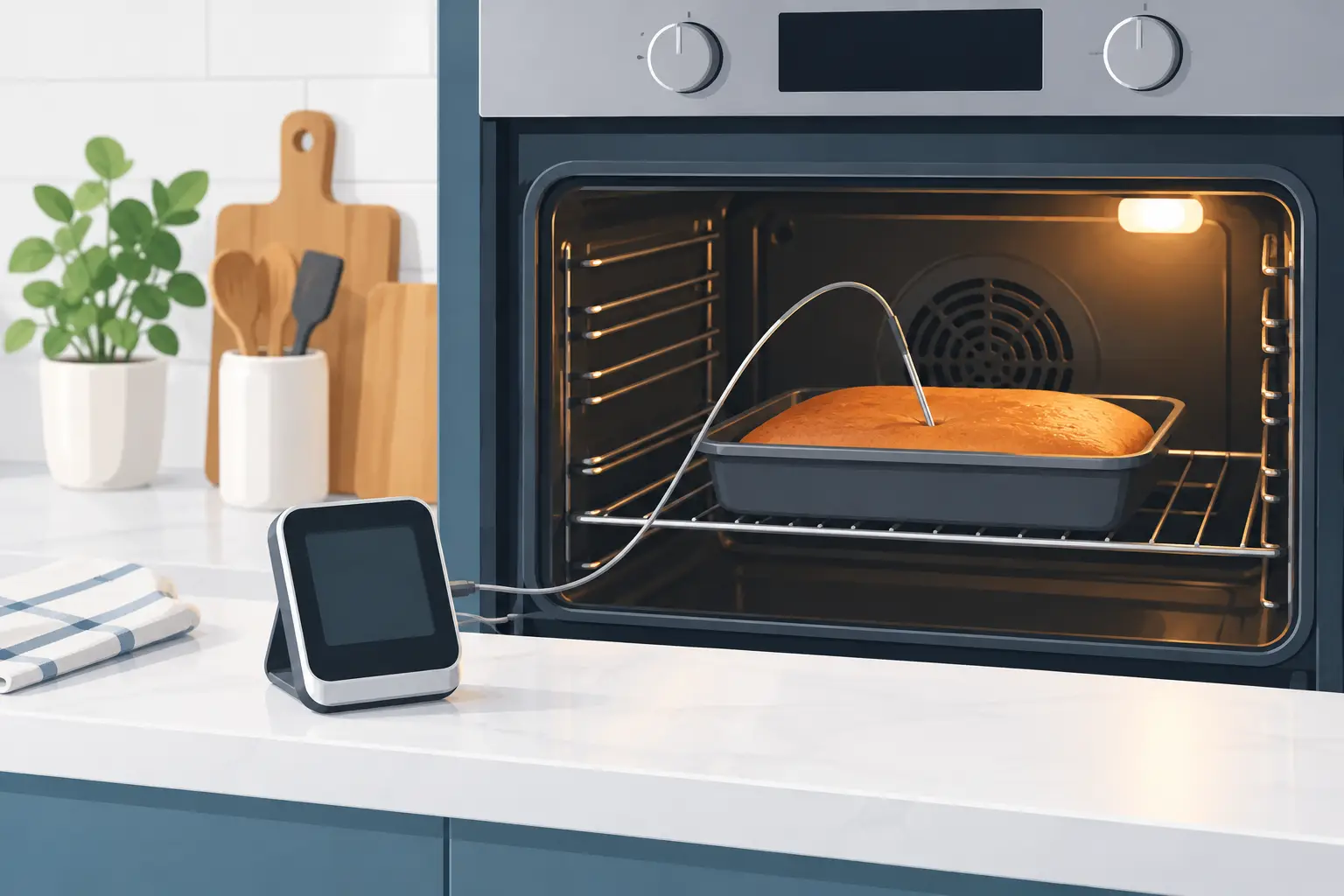
Start with an oven thermometer designed to withstand baking temperatures. A basic hanging analog thermometer can provide a general indication, while a quality digital oven thermometer with a probe can give more detailed readings. No consumer thermometer is perfect, so the goal is to identify a consistent pattern, not to react to a single reading.
Place the thermometer in the center of the middle rack. Avoid letting it touch a rack wall, the oven floor, or a heating element. Set the oven to 350°F and allow it to preheat fully. Once the oven signals that it is ready, leave the door closed for another 15 to 20 minutes.
Check and record the temperature every five minutes for about 20 to 30 minutes. Because the oven cycles, you will see numbers move up and down. Add the readings together and divide by the number of readings to find the average. If the average stays close to 350°F, usually within about 15°F to 25°F depending on the model, the oven may be operating normally.
If it consistently averages well below or above the setting, repeat the test on another day before making adjustments. A poorly placed thermometer, frequent door opening, or checking too soon after preheating can make a functioning oven seem inaccurate.
Test More Than One Area for Uneven Cooking
Temperature accuracy and even heating are related but different issues. An oven can average 350°F in the center but still have a hot spot that burns one side of a sheet pan.
To check for uneven heating, bake a tray of plain bread slices or cookies on the center rack. Use the same size pieces and arrange them evenly across the pan. If one corner consistently browns much faster than the rest, there may be an airflow issue, a weak convection fan, a damaged heating element, or a rack-position concern.
For a quick visual check, look at the bake element in an electric oven when it is cool. Blistering, cracks, burn marks, or sections that do not glow during operation can indicate a failing element. In a gas oven, delayed ignition, a weak flame, or a burner that cycles off too soon should be inspected by a qualified technician.
When Calibration May Solve the Problem
Many modern electric, gas, and wall ovens allow a temperature offset adjustment through the control panel. This setting changes the oven’s response so it runs slightly hotter or cooler than the displayed temperature. The process differs by brand and model, so use the instructions for your specific appliance.
Calibration can make sense when your testing shows a steady, repeatable difference. For instance, if the oven averages 325°F every time it is set to 350°F, a 25-degree adjustment may correct the issue. Make small changes, then repeat the temperature test before relying on the oven for baking or holiday meals.
Calibration is not a cure for a mechanical or electrical failure. If the temperature swings widely, takes far too long to preheat, overheats unpredictably, or changes from one cooking cycle to another, adjusting the display can mask the real problem. That often leads to more wasted food and can put additional strain on oven components.
Signs You Need Oven Repair Instead
A temperature test is a helpful first step, but several symptoms call for professional diagnosis rather than further experimenting. Schedule service if the oven is more than 25°F off after repeated testing, especially when the difference keeps changing. An oven that reaches 400°F when set to 350°F one day and struggles to reach 300°F the next is not simply out of calibration.
Other warning signs include a burning smell, sparks, a tripped breaker, a gas odor, an oven door that will not close securely, or an error code on the display. Turn the appliance off if you smell gas or see smoke, and do not continue testing it.
Slow preheating is also worth addressing. A large oven takes longer to heat than a compact unit, and opening the door adds time. Still, a standard oven that needs 25 to 30 minutes or more to reach 350°F may have a weak bake element, failing igniter, sensor problem, or control fault.
A technician can test the sensor resistance, evaluate element performance, inspect wiring, verify gas ignition, and determine whether the control board is sending the correct signals. This is particularly useful when the display appears normal but food results are not. The source of the problem is not always visible from inside the oven.
Simple Habits That Help Your Oven Cook More Reliably
Once you know the oven is heating correctly, a few everyday practices can improve cooking results. Give the oven enough time to preheat before adding food, especially for baking. Keep pans centered on the rack and leave space around them so hot air can circulate.
Avoid lining the oven bottom or covering racks with foil unless your manufacturer specifically allows it. Foil can block airflow, reflect excessive heat toward components, and affect sensor readings. It can also cause spills to bake onto surfaces where they are harder to remove.
Keep the door gasket clean and check it occasionally for tears, gaps, or areas that have pulled loose. A compromised seal lets heat escape, extends cooking time, and can make nearby cabinets feel unusually warm. If your oven has convection, make sure the fan is not making grinding noises or stopping during a convection cycle.
For Orange County homeowners who rely on their oven for daily meals, a dependable temperature matters more than a number on a display. If your test shows a consistent problem or your oven is cooking unpredictably, AK Appliance Repair can provide an in-home diagnosis, clear repair recommendations, and the parts needed to help get dinner back on schedule.