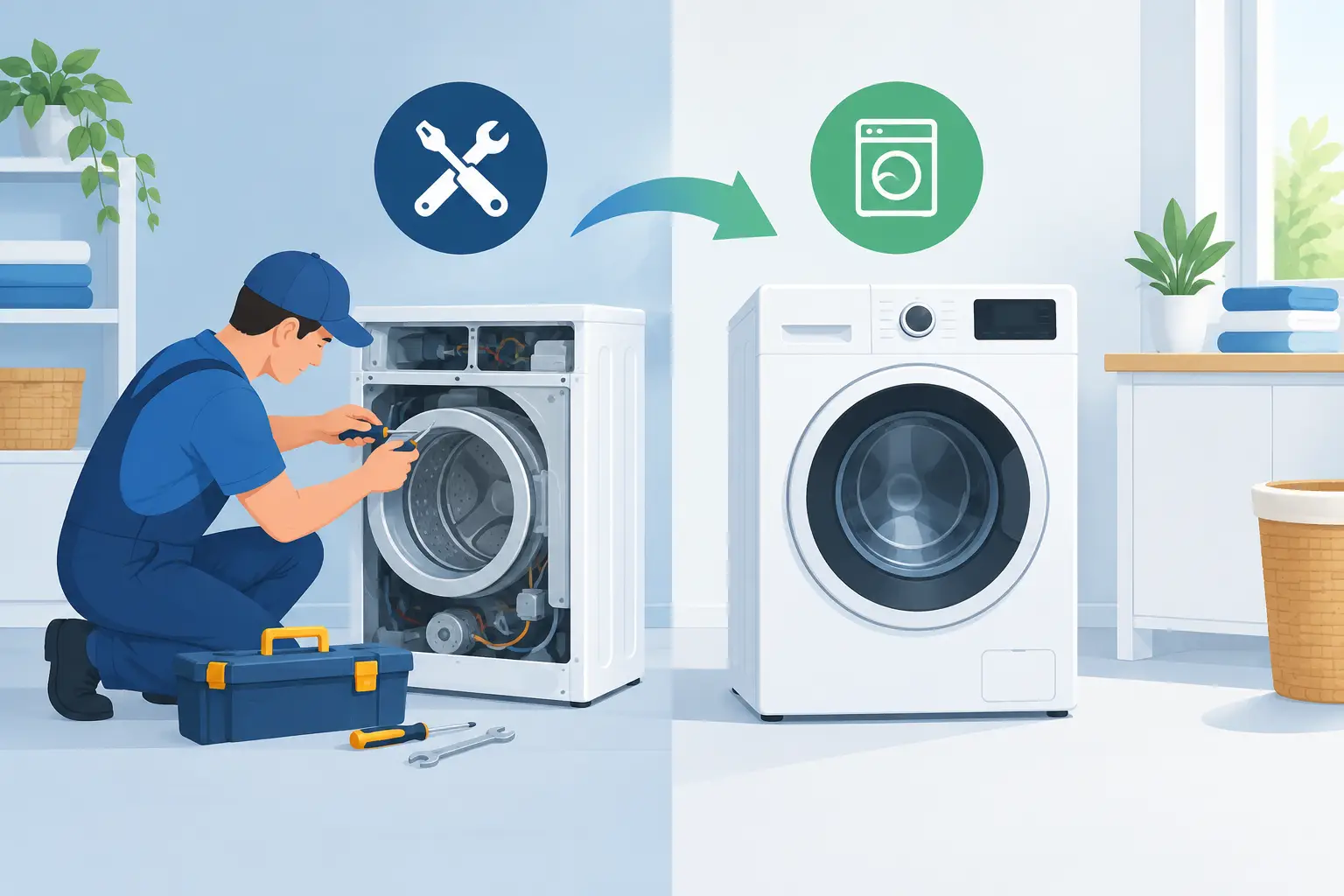
A washer that stops mid-cycle can turn an ordinary week into a pile of damp clothes, missed uniforms, and trips to the laundromat. When homeowners are weighing repairing versus replacing washing machines, the right answer is rarely as simple as “old means replace.” The failure, the machine’s age, the cost of the needed part, and the condition of the rest of the appliance all matter.
A professional diagnosis is the fastest way to replace guesswork with a clear decision. Some washer problems are straightforward repairs that can restore years of reliable use. Others point to an expensive failure or a machine that has reached the end of its practical service life. The goal is not to push a repair at any cost. It is to make an honest choice that protects your budget, your home, and your laundry routine.
Start With the Problem, Not the Age
A washing machine can look old and still be a good candidate for repair. It can also be fairly new and need a major repair after a power surge, bearing failure, or manufacturing issue. Age provides useful context, but the symptom tells you where to begin.
For example, a washer that will not drain may have a clogged pump, a worn drain pump, or an obstruction in the hose. A machine that will not spin may have an unbalanced load, a faulty lid lock, a damaged belt, or a control issue. Water on the floor could come from a loose hose connection, a worn door boot on a front-load washer, or a more involved tub-related problem.
These issues have very different repair paths and costs. Continuing to run a leaking washer can damage flooring, cabinets, and nearby walls, while repeatedly forcing a machine through a failed spin cycle can place more strain on other components. Turning the washer off and scheduling service is usually the safer move.
When Repairing a Washing Machine Makes Sense
Repair is often the sensible option when the washer has a single, identifiable problem and is otherwise operating well. Replacing a drain pump, inlet valve, door latch, belt, suspension component, or damaged hose can cost substantially less than buying and installing a new machine.
It also makes sense to repair a washer that is within its expected lifespan. Many standard washers provide roughly 10 to 13 years of service, depending on use, maintenance, model quality, and water conditions. Premium and luxury models may justify repair for longer, particularly when they were built with higher-quality components and are supported by available factory parts.
A repair can be especially worthwhile if your washer has been dependable until now. If it cleans effectively, does not leak, has no unusual grinding sounds, and has not needed repeated service, one failed part does not automatically make it a replacement candidate.
For Orange County households, repair may also be the more convenient choice. Buying a new washer can involve researching models, checking delivery windows, arranging removal, measuring doorways, and waiting for installation. An in-home repair can often return the laundry room to service much sooner when the needed part is available.
Repairs that are commonly worth considering
A technician can assess the full condition of the washer, but repairs are frequently reasonable when the issue involves the pump, water inlet system, detergent dispenser, lid or door lock, hoses, belts, shocks, suspension rods, or select electronic components. These parts can fail without meaning the entire machine is worn out.
Even a control board repair can be worth evaluating on a newer machine or a premium model. The key question is whether the repair solves an isolated failure or whether it is one of several signs that the washer is declining.
When Replacing the Washer Is the Better Call
Replacement becomes more attractive when a repair is unusually costly compared with the price of a comparable new machine. A practical guideline is to consider replacement when the repair cost approaches half the cost of a suitable replacement, especially if the washer is already near or beyond its expected lifespan.
That guideline is not a hard rule. A $500 repair may be difficult to justify on an older entry-level washer, but it could make good sense for a high-end Miele, Bosch, or other premium appliance with years of value remaining. Features, build quality, matching laundry equipment, and replacement availability all affect the decision.
Major mechanical failures deserve closer scrutiny. A damaged tub, failed transmission, bad bearings in a design where they are difficult to replace, or severe corrosion can create a repair estimate that is hard to justify. The same is true when multiple systems are failing at once, such as a washer that leaks, makes grinding noises, and has recurring electronic errors.
Replacement may also be the safer choice if the appliance has a history of repeated breakdowns. Paying for several small repairs over a short period can become frustrating and expensive, even if no single repair seems unreasonable. A technician should be able to explain whether the current issue appears isolated or likely to be part of a larger pattern.
Repairing Versus Replacing Washing Machines: Costs Beyond the Estimate
The repair estimate matters, but it should not be the only number in the decision. A new washer comes with costs that are easy to overlook: delivery, installation, haul-away, possible new hoses or electrical work, and time away from work to manage the appointment. If your washer is stacked, built into a tight laundry closet, or part of a matched set, replacement can be more involved than the sticker price suggests.
On the other hand, a newer washer may offer lower water and energy use, a larger capacity, or features that better fit a growing family. If your current machine regularly leaves clothes too wet, cannot handle your household’s laundry volume, or no longer fits your needs, replacement may deliver benefits that go beyond avoiding repairs.
Do not assume that a new machine will always be cheaper to operate or easier to maintain. Some high-efficiency models use more complex sensors, pumps, and electronics. Choosing the right replacement involves balancing efficiency, capacity, reliability, and access to qualified service for the brand you select.
Questions to Ask Before You Decide
Before approving a repair or shopping for a replacement, ask for a clear explanation of the failure and the estimate. You should understand what part has failed, whether other components show unusual wear, and whether genuine manufacturer parts are available.
It also helps to ask how the repair affects the washer’s likely remaining life. No technician can promise that another part will never fail, but an experienced professional can explain the machine’s overall condition and whether the repair is expected to provide a reasonable return.
Consider your household’s immediate needs as well. A family with young children may value the speed of restoring a reliable washer, while a homeowner planning a renovation within the next year may prefer to replace the appliance now. There is no one-size-fits-all answer, which is why an accurate in-home diagnosis is valuable.
Get a Clear Recommendation at Home
A washer does not need to be hauled away simply because it has stopped working. AK Appliance Repair provides in-home washer diagnostics for Orange County households, with clear estimates and honest recommendations based on the condition of the appliance. The $75 service fee is waived when you proceed with a repair, helping you put that diagnostic visit toward getting the job done right.
Whether the issue is a washer that will not drain, a machine that shakes violently, a door that will not unlock, or water appearing on the laundry room floor, acting promptly can limit disruption and help prevent further damage. A qualified technician can identify the cause, explain the repair options in plain language, and let you decide with the facts in hand.
The best choice is the one that gives your household dependable laundry service without spending more than the machine is worth. Start with a diagnosis, weigh the repair against the washer’s condition and your plans for the home, and choose the option that brings back confidence every time you press Start.