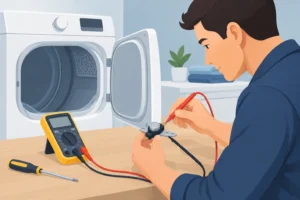
A refrigerator that suddenly feels warm can put a full grocery trip at risk. Before assuming the compressor has failed, take a few safe checks that can narrow down the problem. Knowing how to troubleshoot refrigerator compressor symptoms can help you protect your food, avoid unnecessary replacement, and recognize when a professional diagnosis is the right next step.
The compressor is the small motor-driven pump that moves refrigerant through the sealed cooling system. It is usually located behind a lower rear access panel or underneath the refrigerator. Because several other parts can cause similar cooling problems, a warm refrigerator does not automatically mean the compressor is bad.
Start With Food Safety and Basic Checks
If the refrigerator temperature is above 40 degrees Fahrenheit for more than two hours, move perishable food to a cooler with ice or another working refrigerator. Keep freezer doors closed as much as possible. A full freezer can generally hold its temperature for about 48 hours if unopened, while a half-full freezer may hold it for about 24 hours.
Next, confirm that the appliance has power. Check whether the interior light turns on, whether the display is active, and whether the refrigerator is firmly plugged into a working outlet. A tripped kitchen GFCI outlet or breaker can stop a refrigerator completely. If the outlet is the issue, restore power and allow several hours for temperatures to recover.
Also check the temperature controls. For most refrigerators, the fresh-food section should be set near 37 degrees Fahrenheit and the freezer near 0 degrees Fahrenheit. A control accidentally set too warm, placed in vacation mode, or changed during a power outage can look like a serious cooling failure.
Listen for Compressor Warning Signs
The compressor does not run constantly. Modern refrigerators cycle on and off based on temperature, and variable-speed models may run quietly for long periods. Still, the sounds coming from the lower back area can provide useful clues.
A steady, low hum with mild vibration often means the compressor is operating. If the refrigerator is not cooling despite that sound, the cause may be dirty condenser coils, a condenser fan problem, an evaporator fan issue, a defrost failure, or a sealed-system concern.
Repeated clicking every few minutes is more concerning. The compressor may try to start, click off, and try again. This can be caused by a failed start relay, overload protector, capacitor, control board, wiring issue, or the compressor itself. The start components are less expensive and more common failures than a compressor, which is why proper testing matters before approving a major repair.
A compressor that is extremely hot to the touch, has a burning smell nearby, or repeatedly trips a breaker needs prompt attention. Unplug the refrigerator if you smell burning insulation or see damaged wiring. Do not keep resetting the breaker or continue running an appliance that appears electrically unsafe.
Check Whether the Compressor Is Running
With the refrigerator plugged in and calling for cooling, carefully place a hand near, not on, the compressor housing. You may feel a gentle vibration if it is running. Avoid touching exposed wires, terminals, or electrical components behind the access panel.
No vibration and no sound can point to a power, control, relay, or compressor problem. A humming compressor that becomes very hot without cooling may be struggling. These observations help, but they are not a final diagnosis. Refrigerant pressures, electrical draw, and compressor windings need specialized tools and training to test accurately.
Clean the Condenser Coils and Check Airflow
Restricted airflow is one of the most preventable causes of poor refrigerator performance. On many models, condenser coils sit underneath the refrigerator or behind the rear panel. Dust, pet hair, and kitchen debris can trap heat around the system, forcing the compressor to run longer and work harder.
Unplug the refrigerator before cleaning. Use a refrigerator coil brush and vacuum to remove buildup from accessible coils, vents, and the area around the compressor. Do not bend delicate coil tubing or force a tool into tight spaces. Once cleaned, restore power and give the refrigerator time to stabilize.
If your model has a condenser fan near the compressor, it should run when the compressor runs. A blocked, noisy, or stalled fan can cause overheating and weak cooling even when the compressor itself is still functional. Keep adequate clearance around the refrigerator as well. Tight cabinetry, blocked bottom vents, or items stored against the rear of the appliance can prevent heat from escaping.
Rule Out Problems That Mimic Compressor Failure
A compressor is only one piece of the cooling system. Many refrigerator issues produce the same warm-food or soft-ice-cream symptoms.
A failed evaporator fan can prevent cold air from circulating from the freezer to the refrigerator compartment. You may hear no fan noise when the freezer door switch is held closed, or one section may be cold while the other is warm. A frost-covered evaporator can point to a defrost system failure, where ice blocks airflow. Damaged door gaskets can let humid Orange County air enter the cabinet, creating excess frost and making the refrigerator run longer.
A faulty thermistor, temperature sensor, control board, or damper assembly can also keep the refrigerator from cooling correctly. On premium and built-in models from Sub-Zero, Miele, Thermador, Viking, Wolf, and Fisher & Paykel, electronic controls and specialized cooling layouts make guesswork particularly risky. Replacing a compressor when the actual fault is a fan motor or control component wastes time and money.
When a Compressor Problem Needs Professional Testing
Homeowners can safely verify power, settings, airflow, and visible coil condition. Beyond that point, compressor diagnosis should be handled by a trained appliance technician. Refrigerators contain high-voltage electrical connections and a sealed refrigerant system. Opening refrigerant lines, bypassing start devices, or attempting to recharge a system without proper equipment can create safety hazards and may damage the appliance.
A technician can test the start relay and overload, inspect the inverter or control board on variable-speed models, measure voltage and amp draw, and evaluate whether the compressor is mechanically locked or electrically failed. They can also look for signs of a refrigerant leak or restriction. These faults require different repairs, and the best recommendation depends on the refrigerator’s age, condition, brand, and part availability.
Compressor replacement can be worthwhile on a newer, well-maintained refrigerator, especially a high-value built-in or luxury model. On an older basic refrigerator with multiple failing components, replacement may make more financial sense. An honest diagnosis should explain both options clearly rather than treating every warm refrigerator as a compressor replacement.
Avoid These Common Troubleshooting Mistakes
Do not unplug and immediately restart the refrigerator repeatedly. After a power interruption, wait at least five minutes before restoring power so system pressures can equalize. Do not use a sharp object to chip ice from freezer panels, since puncturing a refrigerant line can turn a manageable repair into a major one.
Avoid moving the refrigerator onto its side unless the manufacturer specifically permits it. If it has been tilted during a move, allow it to stand upright for several hours before plugging it in. Oil in the compressor needs time to settle back into place.
It is also wise to avoid buying a compressor, relay, or control board based solely on a video or a clicking sound. Refrigerator designs vary widely, and an incorrect part can leave the original problem unresolved.
Get a Clear Refrigerator Repair Diagnosis
If cleaning the coils and confirming airflow do not restore cooling, schedule an in-home diagnosis before food spoilage becomes a larger problem. AK Appliance Repair serves Orange County households with clear estimates, on-site refrigerator repair, and service for standard and premium brands. The $75 service fee is waived when you proceed with the repair.
A refrigerator compressor problem can feel urgent, but a careful diagnosis often reveals a repairable cause before replacement becomes necessary. Protect your food, avoid unsafe electrical or refrigerant work, and get the appliance checked while there is still time to save the rest of the week’s groceries.